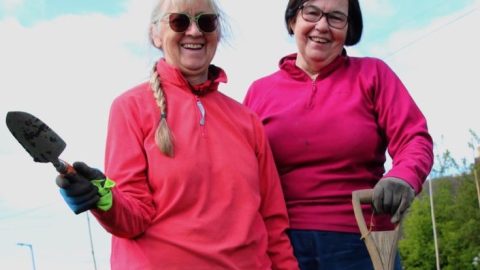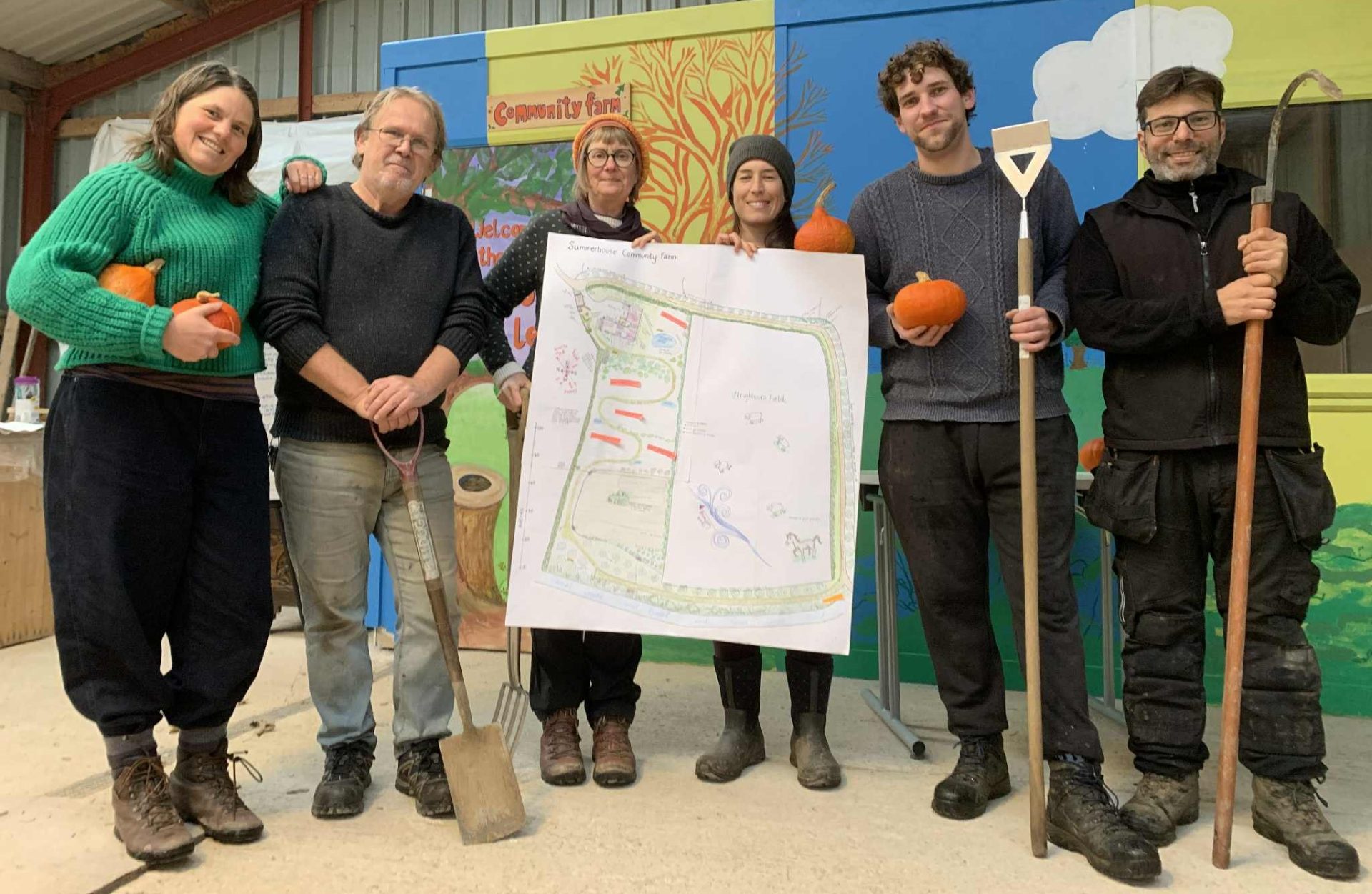
From left: Ellen Pearce, Chris Coats, Janet Swan, Anna Clayton, Finn Payne and Dennis Touliatos at Summerhouse Community Farm.
Plans for a new community farm in Lancaster that include organic food growing, an agricultural classroom, orchards and wildflower areas have been revealed.
The detailed plans for Summerhouse Community Farm off Ashton Road have taken shape over the last six months, following the purchase of the three acre site by Lancaster Community Interest Company LESS in March.
The site was bought on a 999 year lease as part of a wider FoodFutures strategy to see more land being put into community ownership and used for sustainable agriculture, education, and growing healthy soils and sustainable food for nearby residents.
Many individuals and organisations have contributed to the plans after extensive consultation with neighbours, community groups and other interested parties.
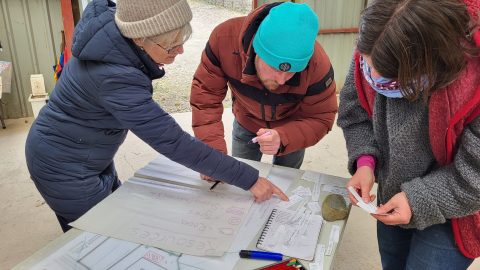
Over the summer, LESS shared a farm survey, leafleted the farm’s surrounding neighbourhoods and coordinated a series of events over the summer and autumn to invite further visions for the site.
It also welcomed visitors for the first time, and developed basemaps to start co-creating a permaculture design.
Some of the organisations that responded to the survey included Scotforth St Pauls Primary School, Lune Valley Beekeepers, The Plot, LDCVS, Harmony With Nature, Food Rise, Good Things Collective, Lancaster City Council, Lancaster District Green Spaces and the FoodFutures partnership.
Recent events have included an open day, compost toilet co-design series, a bio blitz, a biofertiliser making workshop, a water harvest design workshop with Rod Everett from Backsbottom Farm, and an introduction to regenerative enterprise workshop.
Anna Clayton, coordinator of the FoodFutures network, said: “This design seeks to generate renewable energy, build soil health and retain water in the soil.
“It will do this by working with the natural contours of the site to create perennial strips or swales higher up on the slope…where land is cultivated in order to reduce the risk of soil erosion and encourage water to soak into the land.
“Paths will also follow these contours.
“Rainwater will be harvested from the site’s barn and a holding pond and gravity fed irrigation systems will be created to help retain water in times of surplus in order to water key areas during dry spots.
“Solar panels will also be installed on the barn roof.”
Part of the plan includes relocating The Plot – a one acre organic market garden and FarmStart training programme currently located at Old Holly Farm near Garstang – to Summerhouse Community Farm.
Areas on the site have also been identified for other groups to take on, but have not yet been designed.
This could include space for youth groups or a food club to grow food, or for use as organic allotments.
Areas have also been identified for honey bees if the right beekeeper should come along.
In the longer term the large L-shaped barn on the site will include an agricultural classroom, a compost toilet, secure storage for tools, a workshop space for compost bay building and biofertiliser making, a food storage and packing area, a farm kitchen for cooking and processing produce grown on site, a seed drying and storage area and an office space for the site’s users.
A series of workshops and workdays and now being planned to start building the site’s community.
LESS and FoodFutures will also be shaping up proposals for the site’s governance and regenerative organisation design over the next few months.
The first planned work session is hedge laying on Thursday 11 December 9.30am – 12.30pm with Ian Proctor from the Fairfield Association.
For more details and to join this session see: www.trybooking.com/uk/FRGQ
You can view the design in full and share your feedback by the end of December HERE.
A POTTED HISTORY OF THE SITE
While it can be hard to identify the history of individual fields, we can see fragments of the remains of common land, allocated into strips for individuals to farm and an associated lane system for access in the District.
What we do know is that in the 1860s, plans started developing for what later became the Royal Albert Hospital which was situated on the other side of Ashton Road. In 1864 James Brunton, a Quaker, offered £2000 to build a new institution in Lancaster, separate from the County Lunatic Asylum on Lancaster Moor, for the care of those with ‘lesser mental illnesses’.
It was set up as a County Lunatic Asylum, and right from the start in 1870, gardening was encouraged as a pastime on the main site for all the young patients. As early as 1875 we read of there being a farm, newly erected farm buildings and a farm bailiff.
As patient numbers grew, so did the associated farm, which aimed to train patients in farming skills, provide food for the asylum and also make some profit. It’s likely that the site of the new community farm was added to the hospital farm estate sometime before 1917.
Because the farm was a training establishment, it was a mixed farm, as was normal then in north Lancashire. Cattle, sheep, pigs and a few poultry were kept, there was a dairy, and crops such as grain, potatoes, turnips, carrots and hay. Together they provided a wide range of farming skills that the patients could learn.
The farmland which is the site of the new community farm was sold off in 1996 and the community farm fields are now amongst a patchwork of holdings held by local owners.
Albeit a very different context, there are resonant themes between the land use of the past and the intended community farm aims of growing food, agriculture education and feeding the local community.
Historical research thanks to Gordon Clark.