Closing Loops composting coordinator Diana McIntyre explores ways communities and businesses can respond to new food waste regulations.
For many, throwing fruit and vegetable peelings into the bin is an unpleasant but unavoidable part of cooking. Homes with limited outside space offer little opportunity for composting food waste and council collection of food waste was stopped in Lancashire in 2016. However, things are about to change! Community approaches to composting are springing up around North Lancashire offering people opportunities to compost close to home whilst the council will restart doorstep food waste collections in 2026.
Composting in your community

From today, you could get involved in a local community composting scheme. These are hyperlocal schemes created by you and your neighbours. Support is available to set these up. Food waste is composted collectively with the peat-free and cost-free compost shared between neighbours and local growing projects.
There has been an extremely enthusiastic take-up of these local schemes. You don’t need any experience or knowledge to be part of one. As Sharon Phillips, who joined the Scotch Quarry scheme says,
“I’ve always wanted to be more proactive in how I dispose of our food waste but didn’t have the time, knowledge, skills, or space to set up our own composting bin. Being part of the Scotch Quarry scheme means I’ve had some advice on what food I can put in, all I have to do is collect it in the caddy and take it down to the bins knowing that our composting monitors have the technical knowledge to turn it into compost.”
What about business food waste?
Could your employer, organisation, or business put their food waste to good use? From April 2025, businesses of a certain size will need to separate their food waste and get it collected. The regular waste collectors will charge to take it out of sight, but will it be out of mind? It is likely to go to anaerobic facilities outside the district. Is there an alternative?
Having food waste transformed locally into peat-free, living compost, can be appealing to businesses who want to please customers with an environmental outlook. There is also increasing demand for high-quality peat-free compost from growers who are adapting away from peat-based products.

One option is small-scale compost schemes to process food waste from businesses. There are schemes running successfully elsewhere in the UK and further afield that have developed successful approaches. Closing Loops has published a study exploring the feasibility of such schemes including issues such as set-up costs, finding appropriate space, logistics, and financial models.
Get involved
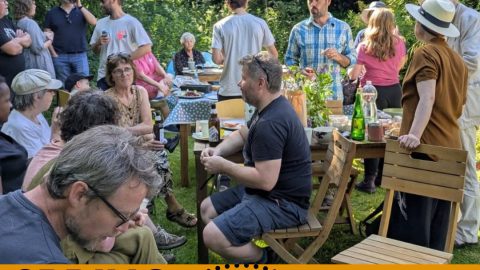
For inspiration or to get involved, keep your eyes peeled for upcoming ‘Community Composting’ events on the what’s on page. All are invited to the Scotch Quarry community composting scheme’s first birthday celebration on 13 October.
To find out about having a local community composting scheme in your area contact diana_cl@lessuk.org
Have a look at foodfutures.org.uk/composting to find out about community composting in the district.
Read the business food waste composting feasibility study report or a one-page summary at bit.ly/business-food-waste